2026 HQ Meeting, Airfreight, Member Engagement, and US Tariffs

2026 FIATA HQ Meeting: Turkish Airlines is the Official Event Airline
Turkish Arilines, as part of its partnership, with FIATA, is offering discounted fares for registered participants of the 2026 FIATA HQ Meeting taking place 30 March – 2 April 2026. To proceed with the online booking tool, please visit turkishairlines.com and use the event code 087TKM26 under the Promotion code field at the payment page.
Building on the great success of previous editions, this year's meeting will mix interactive workshops with panels, bringing together FIATA Members, supply chain actors and industry leaders to tackle the most pressing challenges facing the sector.
From digitalisation and emerging technologies to airfreight risk management, sustainability compliance, e-commerce, and the new NCD Convention, the 2026 programme offers a wide range of sessions designed to deliver real value for freight forwarders. Regional Committee Meetings and Working Group sessions will also provide dedicated space for strategic alignment and collaborative action.
The event will open with a Welcome Reception on the evening of Monday, 30 March — a wonderful opportunity to reconnect with colleagues and friends from across the global logistics community. Participants will also have the opportunity to immerse themselves in Italian culture on the evening of 1 April, immediately after the closing session, hosted by Federazione Nazionale delle Imprese di Spedizioni Internazionali (FEDESPEDI) — a wonderful occasion to network, celebrate, and look ahead to the 2026 FIATA World Congress, to be held in Milan, Italy, from 6–9 October 2026. An event not to be missed!
Airfreight: FIATA and AfA Strengthen Collaboration at Orlando Conference
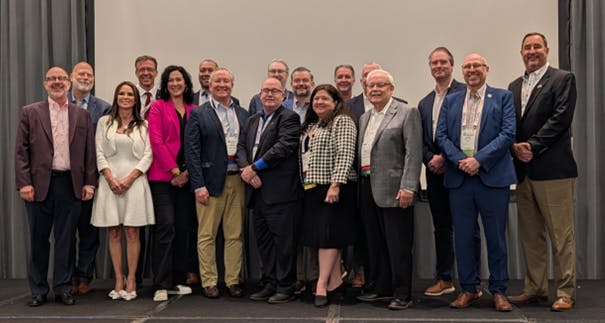
On Saturday, 14 February, FIATA Director General, Dr Stéphane Graber, met with the Board of Directors of the Airforwarders Association (AfA), to deliver an update on FIATA’s vision, priorities, and planned activities for 2026 in relation to air cargo. This exchange further reinforced the strong collaboration between FIATA and its Association Members, including AfA.
FIATA expressed its appreciation to Mr Bob Imbriani, President of AfA, for dedicating his time and expertise, together with other senior industry leaders, to work towards a Global Air Cargo Programme as a forwarder representative in the IFCC Modernisation Working Group under the IATA (International Air Transport Association)–FIATA Consultative Council (IFCC), within the framework of the IATA Cargo Agency Programme. FIATA warmly welcomes AfA’s active engagement in this important initiative and looks forward to continued cooperation on the modernisation of the global cargo agency framework.
Later in the week, Dr Graber participated as a speaker alongside Mr Glyn Hughes, then Director General of TIACA, and Mr Jonathan Gold, Vice-President of Supply Chain and Customs Policy at the US National Retail Federation (NRF), at the General Meeting of AfA, held in conjunction with the Air Cargo Conference in Orlando, Florida.
With over 60 speakers, 100 exhibition booths, and approximately 1,000 attendees, the annual Air Cargo Conference brings together airlines, airport operators, freight forwarders, express operators, and technology providers from across the air cargo ecosystem. The conference is supported by three influential US associations representing air cargo, freight forwarding, airlines, and airports—Air and Expedited Motor Carriers Association (AEMCA), Airports Council International - North America (ACI‑NA), and FIATA Member AfA.
The event provided an important platform to highlight how air cargo is becoming increasingly data‑driven, with freight forwarders accelerating digitalisation to improve efficiency and resilience. In this context, FIATA continues to promote three core pillars: interoperability, clear data governance, and cyber resilience.
FIATA remains firmly focused on protecting and strengthening the role of freight forwarders—particularly SMEs—amid growing safety regulations, rapid digital transformation, and structural change in the air cargo sector. While concentrating its advocacy efforts within the IATA Cargo Agency Programme, FIATA continues to oppose unbalanced or impractical proposals, while working constructively with IATA to ensure that forwarder processes are accurately reflected in key industry tools.
Over the next 12 to 18 months, FIATA anticipates increased regulatory pressure (including Pre-Loading Advance Cargo Information (PLACI)/Advance Cargo Information (ACI), Air Cargo Advance Screening (ACAS), and Import Control System 2 (ICS2)), accelerated digitalisation, and further progress towards a modern Global Air Cargo Programme. This programme aims to provide freight forwarders and airlines with a structured and harmonised framework to jointly advance safety, operational efficiency, digitalisation, sustainability, and fair financial practices.
FIATA and its Director General would like to extend their warm thanks to the entire AfA team for their invaluable support to the industry.
Airfreight: FIATA Pays Tribute to AfA's Brandon Fried Ahead of Retirement
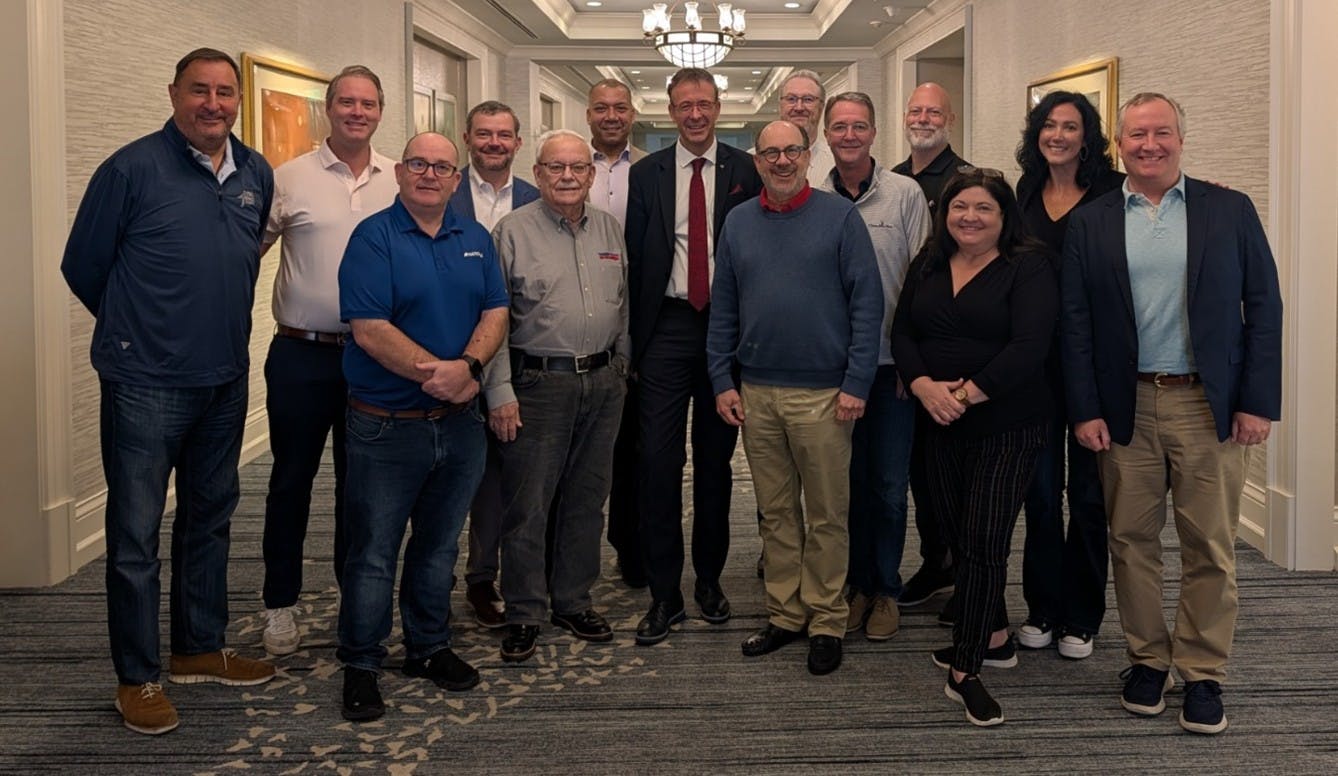
AfA Executive Director Mr Brandon Fried, alongside members of the AfA Board and FIATA Director General, Dr Stéphane Graber.
On the occasion of the Air Cargo Conference, Mr Brandon Fried, Executive Director of the Airforwarders Association (AfA) and a valued friend of FIATA, announced the news of his planned retirement at the end of 2026.
Brandon has led AfA since 2005, following two consecutive terms as AfA Chair from 2001 to 2005, marking more than two decades of dedicated service to the association and the wider air cargo industry. His expertise, institutional knowledge, and unwavering commitment to the sector are widely recognised and deeply respected. The announcement of his forthcoming retirement is received with genuine regret across the industry.
During the transition period, Brandon will continue to lead AfA’s activities across policy engagement, advocacy, and member services, ensuring continuity and stability for the association and its stakeholders.
FIATA warmly thanks Brandon for his exceptional contribution to the air cargo industry and looks forward to continuing the close and constructive collaboration with him and AfA in the years ahead, as well as during the transition towards the next chapter for AfA.
Membership: FIATA and SPEDLOGSWISS Strengthen Ties

FIATA Director General, Dr Stéphane Graber, and the FIATA HQ Team were pleased to welcome Mr Thomas Schwarzenbach, Director of SPEDLOGSWISS, together with Mr Tom Odermatt, Manager Customs and Forwarding, SPEDLOGSWISS, for their first official visit to the FIATA Headquarters in Geneva.
The meeting provided an opportunity for an in-depth exchange on a comprehensive agenda, beginning with legal matters, notably the Negotiable Cargo Document (NCD) Convention, adopted by the United Nations in December 2025, following its approval by UNCITRAL in July 2025, with the active support of FIATA. FIATA’s Legal Services Director, Ms Andrea Tang, presented an overview of the Convention, and its relevance for Switzerland and other landlocked territories was discussed. Expectations and potential engagement by SPEDLOGSWISS with Swiss authorities—supported by Swiss industry leaders and FIATA—were also explored and agreed upon.
On training and education, FIATA Head of Training and Programmes, Ms Sofia Aiche, discussed SPEDLOGSWISS’ apprenticeship framework and the delivery of the FIATA Diploma. Alignment with FIATA Minimum Standards and the participation of SPEDLOGSWISS in the Young Logistics Professionals (YLP) Award were also examined. These discussions concluded with the agreement on a future visit by the Head of Training and Programmes to Basel to further strengthen collaboration and synergies between FIATA and its Association Members.
Further discussions addressed the representation and engagement of SPEDLOGSWISS within FIATA going forward. The Director General underlined the importance of institutional representation and active involvement of Association Members in shaping FIATA’s strategic direction and activities. An update on FIATA governance was provided, highlighting the role of the FIATA Extended Board as an advisory forum to the Presidency, responsible for coordinating FIATA’s activities and programmes. As such, the Extended Board and its members play a central role in bringing forward ideas and initiatives to further develop the Federation. SPEDLOGSWISS noted that the role of the Extended Board—and FIATA governance more broadly—may not always be well understood by Federation Members, and would benefit from a dedicated FIATA session to support Associations in better understanding FIATA’s governance framework.
The Director General expressed his strong appreciation for SPEDLOGSWISS' ongoing contribution, with Mr Tom Odermatt expected to further intensify his engagement, notably by taking on a new role as Delegate to the Working Group Sea, following the departure of Mr Markus Warnebold. Opportunities for enhanced communication cooperation were also discussed, with the aim of increasing the visibility of FIATA’s work within the Swiss logistics community and further leveraging SPEDLOGSWISS' participation in FIATA for the benefit of its members. FIATA and SPEDLOGSWISS' communication officers will liaise in the coming weeks to develop concrete communication initiatives.
The meeting was highly constructive and positive, leading to a number of promising initiatives to further strengthen collaboration between SPEDLOGSWISS and FIATA. The four-hour exchange concluded with a convivial moment over an excellent business lunch.
FIATA warmly thanks Mr Thomas Schwarzenbach for his long-standing support and commitment to the Federation. While Mr Schwarzenbach will step down from his position as Director of SPEDLOGSWISS in July, FIATA will greatly regret his departure and is particularly grateful for his outstanding contributions and professionalism. FIATA especially commends his role in preparing a strong and positive transition to his successor, ensuring that FIATA and SPEDLOGSWISS—one of FIATA’s founding members in 1926—will continue to adapt to evolving global expectations and business practices in the best interest of our entire industry.
International Trade and Law: FIATA Contributes Freight Forwarding Perspective at IATA WLS 2026
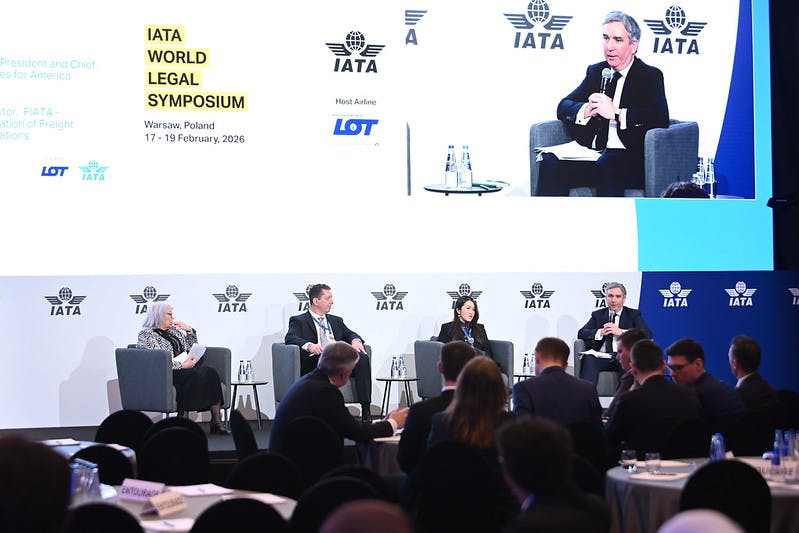
From left to right: Ms Leslie MacIntosh, Corporate Secretary and General Counsel, International Air Transport Association (IATA); Mr Douglas Mullen, Acting Senior Vice-President and Chief Legal Officer, Airlines for America; Ms Andrea Tang, FIATA Legal Services Director; and Mr Michael Gill, Director, Legal Affairs & External Relations Bureau, International Civil Aviation Organization (ICAO).
FIATA participated in the IATA World Legal Symposium 2026, held in Warsaw, Poland from 17–19 February 2026, which brought together more than 300 aviation legal professionals from airlines, law firms, regulators, and international organisations to discuss emerging legal and regulatory challenges in the aviation sector under the theme “Liability in a Changing World”.
Ms Andrea Tang, FIATA Legal Services Director, participated in the Legal Leaders Roundtable, contributing the perspective of the global freight forwarding community on evolving liability considerations affecting the air cargo supply chain. The roundtable was moderated by Ms Leslie MacIntosh, Corporate Secretary and General Counsel, International Air Transport Association (IATA); and featured Mr Michael Gill, Director, Legal Affairs & External Relations Bureau, International Civil Aviation Organization (ICAO); and Mr Douglas Mullen, Acting Senior Vice-President and Chief Legal Officer, Airlines for America.
During the discussion, FIATA highlighted that liability considerations in modern supply chains increasingly extend beyond traditional questions of physical loss or damage. As global logistics systems become more digitally interconnected, the legal landscape must also address emerging risks linked to data governance, cybersecurity, regulatory compliance, and the reliability of upstream data flows across multiple actors in the supply chain.In particular, FIATA noted that initiatives such as Pre-Loading Advance Cargo Information (PLACI) and expanding customs and security data requirements have elevated data quality, accuracy, and accountability to core operational and compliance priorities. In this context, liability risks increasingly relate not only to the physical movement of cargo but also to the information environment in which transport operations take place. Ensuring that data is reliable, properly governed, and transmitted through trusted systems is therefore essential for secure and efficient global supply chains.
FIATA also emphasised that digitalisation introduces new legal considerations, including cybersecurity risks, oversight of automated decision-making through artificial intelligence, data protection and privacy obligations, and trust and security compliance by third-party service providers and digital platforms. In this rapidly converging information environment, data can become an organisation’s greatest asset – or liability – depending on the robustness of the legal and governance frameworks surrounding it.
The discussion also highlighted the continued challenge of legal fragmentation across transport modes, noting that cargo rarely moves by air alone and that multimodal transport operations frequently face gaps and inconsistencies in applicable legal regimes. In this context, FIATA drew attention to the United Nations Convention on Negotiable Cargo Documents, which aims to facilitate digital trade, strengthen legal certainty, and support trade financing in multimodal transportation.
More broadly, FIATA underlined that addressing these evolving challenges requires close collaboration across the supply chain, including airlines, freight forwarders, regulators, and digital service providers. In an increasingly interconnected logistics environment, effective legal and governance frameworks depend on inclusive dialogue and coordinated solutions rather than siloed approaches, ensuring that new initiatives remain operationally workable for all stakeholders.
The symposium provided an important platform for dialogue among legal leaders from across the aviation ecosystem. FIATA welcomed the opportunity to contribute the perspective of the global freight forwarding community and looks forward to continued engagement with partners across the air cargo sector.
International Trade and Law: Navigating the Latest US Tariff Measures

On 24 February, FIATA issued an alert following the Supreme Court of the United States decision striking down several IEEPA tariffs, including reciprocal and fentanyl-related measures. In response, the US Administration introduced a temporary 10% blanket tariff under Section 122 for 150 days. Section 232 and 301 tariffs remain in force, while the continued suspension of de minimis treatment increases customs requirements for low-value shipments. Certain critical minerals, energy products, agricultural goods, pharmaceuticals, and electronics are exempt.
In a recent interview, Mr Frank Desiderio and Mr Arthur Bodek, Partners at GDLSK, highlighted the practical implications:
“US tariff policies are influencing global sourcing decisions. Companies are reviewing production and transaction structures to mitigate higher tariffs. Proper classification dictates duty rates, and origin planning can materially affect outcomes. 2026 will see an uptick in enforcement, so companies must exercise reasonable care in admissibility, classification, and valuation of merchandise. Forwarders also play a key advisory and operational role to manage cost, timing, and compliance risks.US tariff policies are influencing global sourcing decisions. Companies are reviewing production and transaction structures to mitigate higher tariffs. Proper classification dictates duty rates, and origin planning can materially affect outcomes. 2026 will see an uptick in enforcement, so companies must exercise reasonable care in admissibility, classification, and valuation of merchandise. Forwarders also play a key advisory and operational role to manage cost, timing, and compliance risks.”
The full interview will be available in the upcoming FIATA Review.
FIATA Members should refer to the alert and consider the following steps:
- Verify in-transit eligibility documentation;
- Strengthen customs compliance processes;
- Communicate cost impacts promptly;
- Reinforce contractual protections;
- Advise customers on supply-chain options;
- Maintain robust records.
FIATA is monitoring the situation closely and will continue to provide updates and guidance. For specific questions, contact [email protected].