Resilience, Safety and Security, Customs & the Latest FIATA Review

International Trade: Panama Canal Pressures Put Supply Chain Resilience to the Test
Global maritime trade is facing a particularly challenging combination of pressures. The Panama Canal is contending with a structural capacity constraint driven by El Niño-related drought, while disruption around the Strait of Hormuz is creating a major geopolitical shock. With transit through the Middle East severely restricted, oil and gas carriers are shifting towards Atlantic routes, adding pressure to maritime corridors already operating under constraints.
The result is a maritime double choke point. As demand for alternative routes rises, Panama is limiting daily canal transits to around 32–34 slots. For shippers, agents and freight forwarders, this combination of restricted capacity and shifting trade flows is changing how cargo movements are planned. Traditional just-in-time supply chains are increasingly giving way to more defensive logistics strategies designed to absorb disruption.
In practice, this means securing canal transit slots months in advance to reduce exposure to spot-market volatility, while some operators are setting aside multi-million-dollar reserves to bid for emergency slots. Draft restrictions are also prompting vessels to unload containers at nearby hubs before entering the canal, while heavy or non-urgent cargo may be diverted around the Cape of Good Hope. At destination ports, higher inventory levels are being maintained to provide a buffer against delays of 7 to 11 days.
Alternative solutions offer some relief, although none can fully replace the canal's capacity. The Transisthmian Railroad provides an important escape valve, allowing containers to be discharged on one coast, transported across Panama by rail and reloaded on the other. This option comes with additional handling and port costs, however. Meanwhile, shifting cargo to other regional land bridges is difficult when nearby gateways such as Cartagena are already operating close to capacity.
There is also a fundamental scale challenge. No existing overland alternative has the infrastructure or capacity to replicate the volume that can move through the Panama Canal on a single Neo-Panamax vessel.
For FIATA and the global freight forwarding community, the situation highlights a fundamental reality of modern logistics: resilience depends on having viable alternatives before disruption occurs. As environmental conditions, geopolitical tensions and infrastructure constraints increasingly intersect, freight forwarders are having to look beyond individual routes and build greater flexibility, visibility and contingency into global supply chains.
FIATA continues to monitor the situation closely and is developing new tools and resources for its Members to support operational decision-making, to be launched at the FIATA World Congress.
Safety and Security: Lithium Battery Fires Highlight Importance of Shared Action on Cargo Safety

Recent reports of fires involving lithium-ion batteries aboard vessels have renewed attention on the safety risks associated with dangerous goods in container shipping. With battery volumes increasing and such fires particularly difficult to contain, ensuring accurate cargo information and the safe handling of dangerous goods remains a common priority across the maritime supply chain.
Industry initiatives to address misdeclared cargo and identify potentially high-risk shipments are an important part of these efforts. FIATA works closely with the World Shipping Council and other cargo shipping stakeholders through the Container Integrity Group (CIG), and will continue this cooperation towards the shared objective of a safe and secure global supply chain.
As new approaches and technologies are developed to address these risks, it will be important that solutions are practical and effective, while appropriately reflecting the respective roles of the different actors across the supply chain. These developments also reinforce the importance of maintaining a sound understanding of the requirements applicable to the transport of dangerous goods. FIATA's Dangerous Goods Brochure (3rd Edition) provides practical guidance on the transport of dangerous goods across all modes, helping freight forwarders to understand applicable requirements, mitigate risks and maintain high safety standards.
FIATA will continue to follow developments closely and engage with its industry partners to support collaborative solutions that strengthen cargo integrity and safety across global supply chains.
Customs: FIATA Urges EU Action Over Retrospective Customs Liability in Poland
FIATA, Community of European Railway and Infrastructure Companies (CER), European Association for Forwarding, Transport, Logistic and Customs Services (CLECAT) and The International Union for Road-Rail Combined Transport (UIRR) have called for urgent European Commission intervention over retrospective customs liabilities imposed by Polish customs authorities on European Union (EU) logistics operators.
The cases concern imports that entered the EU through Małaszewicze, Poland between 2021 and 2026. Following the European Anti-Fraud Office (OLAF) investigations, the imports were found to have been misdeclared by importers using incorrect tariff codes. In several cases, containers had been scanned by customs at the time of entry, with no fraud or irregularities being identified at the time. Polish authorities are now seeking customs duties, VAT, anti-dumping duties and penalties from EU-based logistics operators including freight forwarders, railway undertakings, border agents, temporary storage authorisation holders, and customs agents. The original importers and warehouse operators responsible are often no longer traceable or solvent and there is a risk that operators are being pursued regardless of their role, knowledge or ability to detect the fraud.
Potential liabilities run into hundreds of millions of euros, placing several operators at risk of insolvency before lengthy appeal proceedings can be concluded. Concerns have been raised that this practice could impact the ability of EU-based logistics operators to operate with legal certainty, and could also discourage customs service providers from making customs declarations at the EU’s external borders, potentially causing severe border congestion.
The associations have asked the Commission to clarify the correct application of the Union Customs Code and Common Transit Convention and provide guidance on customs liability rules. They have also proposed a meeting with the Commission and Polish customs authorities to find a quick and commercially reasonable solution.
Click here to read the joint letter from a joint letter from FIATA, CER, CLECAT, and UIRR
FIATA Review: The Latest Issue Is Out!
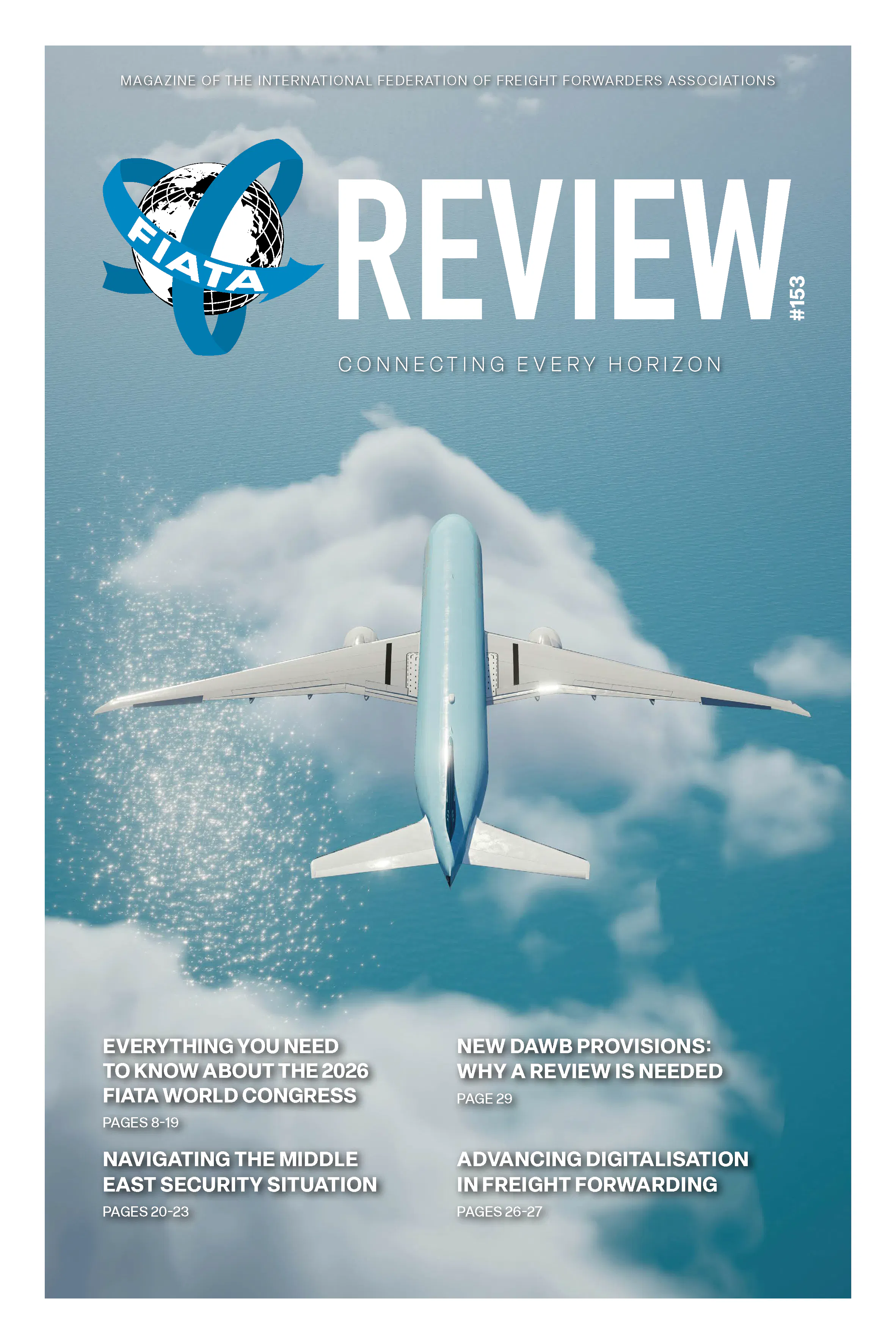
The September issue of FIATA Review is now available, offering a timely pre-read ahead of the 2026 FIATA World Congress, taking place in Milan from 6–9 October as FIATA celebrates its centenary.
Designed to help readers prepare for the discussions ahead, this issue provides a closer look at the themes running through the Congress programme, giving readers valuable context for each session and the questions facing the industry today. From shifting trade flows and multimodal corridors to customs, sustainability, risk and security, the articles set the scene for the conversations to come in Milan.
The FIATA Review also explores several of the issues the industry is facing today such as the Middle East crisis and its impact on global trade and supply chains, to the continued digitalisation of the industry and need for legal standards and the latest Direct Air Waybill (DAWB) provisions and why a review is needed.
The FIATA Review provides an essential starting point for understanding the issues shaping global logistics and the next chapter of freight forwarding.